
WIFT Vic Chats: Sophie Hyde on new feature film ‘Jimpa’
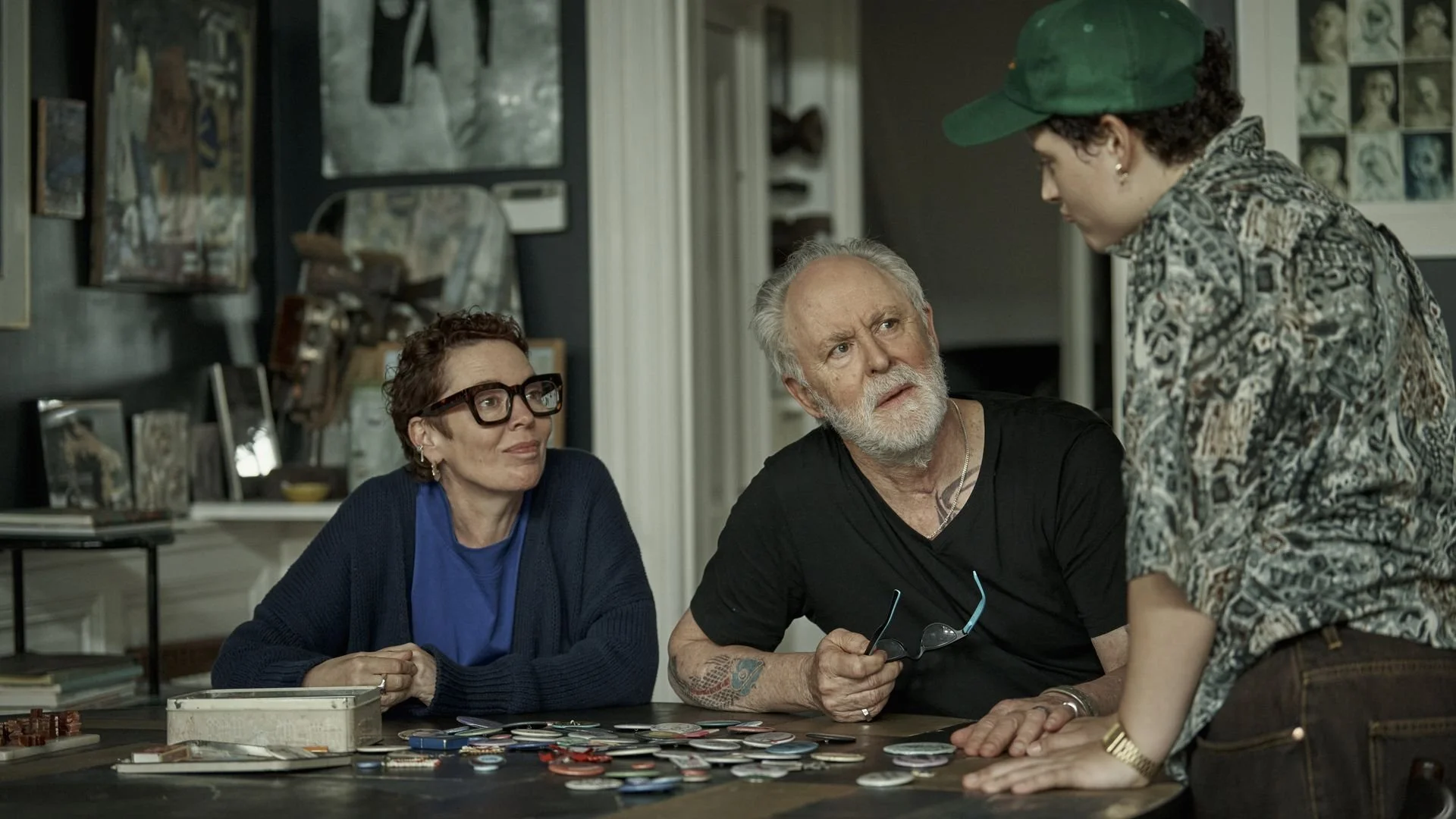
Hannah (Olivia Colman), Jim (John Lithgow) and Frances (Aud Mason-Hyde) in Jim's apartment. Photo Credit Mark De Blok. Courtesy of Kismet
WIFT Vic Vice President Katie Page chats to acclaimed Aussie director Sophie Hyde about their new feature film Jimpa and the vulnerability of adapting personal stories for the big screen.
KP: JIMPA is of course an incredibly personal film for you, being semi-autobiographical. When did you get hit by the revelation that you wanted to share this part of your life with the world on the big screen?
SH: It’s been an incrementally personal film. My father, who was a very provocative, eccentric gay man, driven by social justice, died several years ago and after he died, my own child Aud was becoming increasingly public about their own Queer identity as a trans person. I longed to allow them a conversation about the challenges of being a Queer person and the treatment you will encounter, but also the joy and liberation. That impulse led to the idea of an intergenerational story and my writing partner Matthew Cormack suggested that the middle generation should also be part of it.
I didn’t realise as we started out that would end up being so explicitly personal - the central character is a filmmaker, she has a trans non-binary teenager and a gay father. There are elements of our family story retold in part on the screen. But it’s also very fictionalised. And we very much explore the idea of stories and the multiple truths that can exist and how we create narratives to create meaning - so we use our personal lives to help with that layer of questioning. There are feelings that we draw on, much like every film, and those are deeply felt by us, and at best deeply felt by our audience too, but there are also areas where we wanted to push things for narrative pleasure or to explore something.
And there are some very meta moments in the film - talking about making a film, my own child plays the teenage character. Though a good friend watched it the other day and she came out saying “these guys are nothing like you all” which was very funny and i suspect quite true of all the characters who seem to be based on someone in our lives.
“[...] We very much explore the idea of stories and the multiple truths that can exist and how we create narratives to create meaning - so we use our personal lives to help with that layer of questioning.”
KP: Given how close to home the story is, how did the production and development process differ compared to your previous projects? Was there anything that was easier or surprisingly more difficult?
SH: I have always made with people that are very close to me but the surprising thing about Jimpa was how many new collaborators there also were. We filmed in Australia, the Netherlands and Finland and so it required of us a lot of new relationships.
I stepped into work with our cast and crew offering up very personal things and they met me and shared their feelings and stories also.

Hannah (Olivia Colman). Photo credit Matthew Chuang. Courtesy of Kismet
KP: A classic ice-breaker question is often ‘who would you cast in a film telling the story of your life?’ This is no longer a hypothetical for you! Through the process of casting for someone to play a cinematic version of yourself, did you have any self reflective moments or discover anything new about yourself?
SH: I’m very lucky to have had Olivia in this role. Obviously she is an incredible actor and she’s also very warm and someone that I love dearly. I always wanted Olivia in the role for this particular story and so casting her felt really triumphant for this film. But when I thought about who could play a version of me generally, I felt like it could have been anyone, which led to a kind of self reflective moment.
The writing of the role, the comedy we were exploring about a filmmaker who wants to make a non-confrontational film and has a non-confrontational tendencies in her life, was occasionally confronting. I had to question myself a lot in terms of whether I felt abandoned by my own father and a similar feeling of abandonment as my child moved into adulthood and separation.
These are the questions of our lives, or of my life, and I’m very grateful that I get to explore what it feels like to be a human in relation to others, through stories. I didn’t feel I was in therapy (most of the time), but there were moments where I had to confront myself. I do genuinely think that is true of every film I’ve made though, regardless of how seemingly removed from my life they might seem. That’s how I choose to work.
“Moving our bodies. Rejecting the desire to shrink or put all our attention on how we look. Listening to each other. Helping more people make stories and watching them. Giving a shit. Trying really hard. Not hardening too much. Enjoying being soft, vulnerable creatures. ”
KP: Lastly, if you could offer any advice to other women and gender-diverse filmmakers who are currently developing their projects, what would it be?
SH: I can really only offer advice that I’m trying to give myself right now - to ask questions of myself about the world and how we are going to keep surviving in it, and for those questions to guide the stories I am developing and the way the stories are told.
None of us know what is going to be successful in terms of financial returns or praise or whatever, and there are so many reasons that many of us are excluded from parts of the film industry or sidelined. It’s very real that it’s not an even playing field and that the people who control the money are not always the people you want to be guiding what gets seen. But they are. However, there are also a lot of great and passionate humans working across film. Finding each other, championing each other and holding each other is crucial in this.
And being outside, in the world, with people that you need and that need you is really crucial. Engaging in art together, talking and learning to disagree with each other in a loving way, supporting each other through the collapse of the climate and social structures that we might have felt were strong (or not). Moving our bodies. Rejecting the desire to shrink or put all our attention on how we look. Listening to each other. Helping more people make stories and watching them. Giving a shit. Trying really hard. Not hardening too much. Enjoying being soft, vulnerable creatures.
Jimpa is distributed by Kismet Movies and is showing in Australian cinemas now. Find a session near you via the link below.